

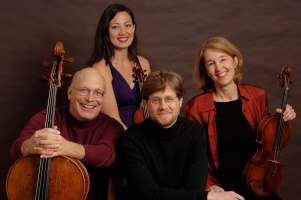
Amelia Piano Trio
Sunday – 11 November 2012 - 3:00 PM
|
Piano Trio in C Major, K. 548 |
Mozart |
|
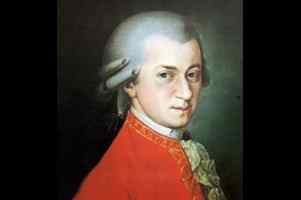
The C major Piano Trio, KV. 548 was completed in July 1788, shortly before the completion of Mozart’s last Symphony "Jupiter" No. 41, also in C major. It is remarkable that in a few summer months in 1788, only a year after his father’s death, Mozart simultaneously wrote his last three symphonies, the culmination of his symphonic work, as well as his last three piano trios. Burdened by his wife's serious illness, which added to his financial stress, he did publish these last piano trios in an attempt to raise funds. The first Allegro begins like the Jupiter Symphony with a fanfare "call for attention", an unusual feature in a chamber music work for strings. The music that follows seems predictable at first, but we are offered a glimpse into the mind of a musical genius, during the development section. The modulations, the descending chromatic lines and the marvelous instrumental range create magical textures where shadow and light, pain and joy mingle. The second movement, an Andante cantabile in F major, develops spaciously in 3/4 time and is stirred by occasional rapidly fluttering passages. A sudden forte exclamation in unison disrupts the tonal complacency, and what follows is unexpected harmonically as well as texturally. The result is bold and hauntingly beautiful. The last Allegro is a jovial "hunting" theme in a dancing 6/8 meter. Unlike the symphony, it is not contrapuntal in texture. An arpeggio figure of the main tune is passed around by all three instruments. |
|
|
Piano Trio in F-sharp minor |
Babajanian |
|
Arno Babajanian, little known in the West, is a national hero in his native Armenia and well known in Russia. As his astonishing musical talent was clearly apparent by age 5, composer Aram Khachaturian suggested that the boy be given proper music training. At the age of 7, he entered the Yerevan Conservatory, then went on to study in Moscow. He later returned to the Conservatory, where he taught in the fifties, and wrote the Piano Trio in F-sharp minor, in 1952. It received immediate acclaim, and was regarded as a masterpiece from the time of its premiere. Most of Babajanian’s music is rooted in Armenian folk music and folklore. The Piano Trio, composed of three substantial movements, is passionate and full of memorable melodies with wonderful writing for all three instruments. The first movement, an Allegro, begins in dramatic fashion with the strings playing the main theme in unison. Like a leitmotif, this theme then reappears in each of the next movements. The second, Andante, begins very softly with the violin introducing the lovely main theme high on its e-string. Eventually the cello joins in, and the theme is intertwined between them in a very original fashion. The Finale, an Allegro vivace is rhythmically quite interesting. Mostly in 5/8 time, it features two themes which stand in stark contrast to each other. The first is rather rough and aggressive while the second is softer and more song-like. The trio ends with the re-appearance of the opening theme, and leads to a short stormy coda. |
|
|
Piano Trio No.3 in C minor, Op.101 |
Brahms |
|
Summer holidays away from Vienna afforded Brahms an opportunity to compose in pleasant surroundings without the city’s inevitable interruptions. In 1886 he spent the summer at Hofstetten, near Thun in Switzerland, where he rented a villa overlooking the lake. There he wrote his second violin, and second cello sonatas, and in the same summer his third piano trio, the Trio in C minor, Op. 101. It was performed in Vienna in December by the composer, with the violinist Hubay and the cellist Popper. The first Allegro opens with strong energy, its intense principal subject followed by a subsidiary theme of equal intensity, with violin and cello singing the theme together. The development combines both subjects, moving, in its course, to the unexpected key of C-sharp minor and followed by a succinct recapitulation and coda. The violin and cello are muted as the Presto opens, with a central Trio section in F minor, as agitato piano chords are accompanied by plucked ascending arpeggios from the strings. Violin and cello start the C major slow Andante with its oddly irregular rhythm, the former presenting the principal theme, then taken up by the piano, which alternates with the string voices. Further rhythmic changes mark the central section of the movement before the return of the principal theme. The last Allegro molto starts with a vigorous return to the minor mode in a principal theme offered by the violin, relaxing into a secondary theme, a material briefly developed before the return of the first theme. A repetition of the second theme leads gradually to the brighter key of C major, in which the movement swells to a conclusion. |
|