

Johannes String Quartet - Notes
String Quartet No. 6 in F minor, Op. 80 Mendelssohn
In May 1847 Mendelssohn learned of the death of his sister Fanny. Because of his extreme fondness for her, the news were to him a shattering and incapacitating blow. Having somewhat recovered by July, he composed this quartet which departs from his usual lighter and genial character, exploiting some of his most anguished, tragic and intense emotions.
The dark key of F minor hangs over all four movements. Along with a tremolo by cello and viola in the lower registers, violins start the Allegro vivace assai with a winding motif that rises to a fortissimo. It is interrupted by an anguished dissonant tune in the high register of the first violin, then echoed by each instrument in the quartet. A lyrical secondary theme is offset by harmonic instability and the movement evolves in an aura of fury. A brief F major moment of tranquility brings a recapitulation of the work's opening music and a driving coda marked Presto. The next Allegro assai is full of heavily accented syncopations and harsh dissonances. A middle section pits the cello and viola playing an ostinato against a macabre waltz-like theme played by the violins. The Adagio is the most personal and elegiac movement of the quartet. It begins with a descending motif on the cello that first seems to continue in the F minor key, though the movement is set in A-flat major. The final Allegro molto opens with a tremolo on the cello accompanying the thematic material on the violins. Dissonance, syncopation and tremolo passages heighten the intensity of the music. In the coda, the triplet figures evident in the quartet's first movement are superimposed onto the main theme, as the first violin soars to the top of its register.
String Quartet in C minor, op. 51, no. 1 Brahms
Brahms was 40 when the first two of his three string quartets were published. He suffered from feeling as if he were under the shadow of Beethoven, and delayed the completion his two Op. 51 quartets until 1873, while on Summer holiday. They were dedicated to his friend Theodor Billroth, an accomplished amateur violist.
Bold and elaborate, filled with rich harmonic structure and frequent double stopping, the Quartet Op. 51, No. 1 in C minor sounds quite symphonic. The opening Allegro presents a restless arching theme, robust, full of seething energy. The second violin leads the way in the gentle, but powerful Romance. The masterful and sensitive accompaniment grows in rhythmic complexity from a mixture of dotted, non-dotted, and triplet rhythms, until all parts are working against each other, but with a restrained feel. Brahms, ever partial to the viola, gives the lead to that instrument in the 3rd movement. In the trio section the second violin is heard in an amusing effect as the bariolage technique is used (alternating stopped/open sounds for the same note) while the viola is given oscillating octaves next to pizzicatos in the outer voices. The Allegro finale returns to the drive and arch shape of the first movement sporting an impatient athletic pace that increases to the end.
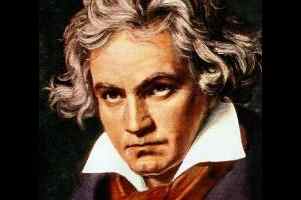
String Quartet No. 16 in F Major, Op. 135 Beethoven
This is Beethoven’s last string quartet and last complete opus in any genre. He finished it in October 1826 as his nephew Karl recovered from a suicide attempt, and just months prior to his last breath in March of 1827. One could expect music created under such unstable circumstances to be anguished, but the piece is radiant music, full of sunlight, as if he achieved in it the peace elusive to him in life. The first Allegretto features short motives, stops and starts, a bit of a light-hearted fugue, and a wonderfully elastic series of harmonic modulations. The contrasting Vivace bristles with energy. Its outer sections rocket along on a sharply-syncopated main idea, while the vigorous trio sends the first violin sailing high over the other voices. In the impressive ending the music grows quiet, comes to a moment of stasis, and then Beethoven wrenches it to a stop with a sudden, stinging surprise. The slow Lento assai is built on the first violin's heartfelt opening melody; the even slower middle section, full of halting rhythms, spans only ten measures before the return of the opening material, now elaborately decorated. The final movement provides us with a riddle as a preface. Above the music, Beethoven writes "Der Schwer gefasste Entschluss" (The Difficult Resolution or Decision), and gives us two short examples of music. The first is marked Grave and contains the question "Muss es sein?" (Must it be?). The second is marked Allegro and states not once, but twice: "Es muss sein! Es muss sein!" (It must be! It must be!). What follows is a musical discussion, going back and forth between the two, with the answer "It Must Be!" triumphantly claiming the end. The piece comes to a close with wit and lightheartedness.